Showing posts with label Kuching. Show all posts

Survival Tips for the Rainforest World Music Festival


Hoooooyyeeaaahhhh!! 5 more days for that time of the year again where flocks of different folks come together for one of the most anticipated event of the year - the RAINFOREST WORLD MUSIC FESTIVAL 2014. This is it's 17th year, voted for the 5th consecutive year as one of the 25 best International Festivals by renowned world music magazine, Songlines


With management experience and worldwide recognition, you can rest assure that the event is as safe as any festival event as can be. Teams of staffs and volunteers alike line up to ensure the event flows according to plan with contingency and action plans accounted for any unplanned events. 

That being said, you, as festival goer, should not neglect your own safety nor the safety of other festival goers.  Remember, have fun responsibly!

The Venue
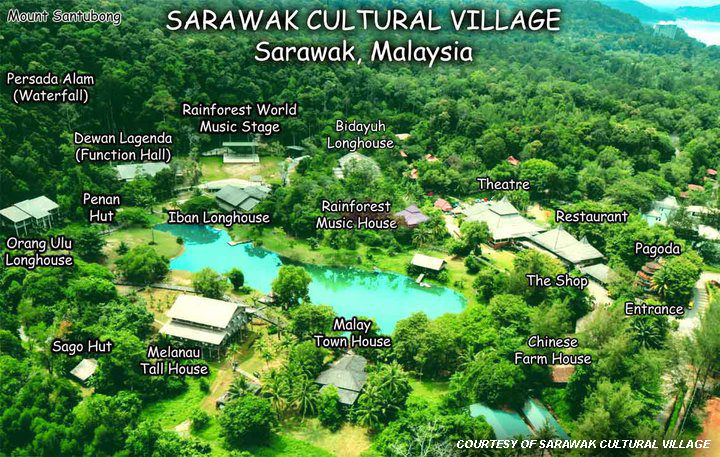
If you've been to the festival in the previous years or are already familiar with the Sarawak Cultural Village grounds, the same general rules still apply since past years. If this is your first time, here's an aerial view of the Sarawak Cultural Village (courtesy of Sarawak CUltural VIllage and rwmf.net)

The Programme
It's worth noting that some visitors to the Rainforest World Music Festival come for the highlight of the whole festival - the evening performance from participating bands from all around the world and spend the day sight-seeing around Kuching Town. The festival has loads and loads to offer, especially for the musical enthusiast looking for exposure and experience. Plan your timing, try to arrive early for the best spots and do join the afternoon workshops or shop for souvenirs at the arts and crafts or memorabilia booths set all over the festival venue. There are also plenty of food stalls if you feel like tasting the local delicacies. You can print out the daily festival program here:


The Dress Code
Kuching, in general, has good whether. However, it can be unpredictable. Dress for comfort. I have seen festival goers particularly ladies wearing high heels to the festival. This is highly discouraged as one, the festival ground spans over a large area and a whole lot of walking is expected; two, the walkways are made up of woodplanks (to reflect the traditional way back when) and there are gaps between the planks; three, the front-stage or 'mosh-pit' is earth, not paved, not woodplanks. 

I recommend t-shirt or tank tops, especially those made with jersey or quick dry material, shorts, and flip-flops. 

Accessories
I cannot stress this enough. Last year was my second time going to the festival, and my first as a media representative - on which I made a couple of small but costly errors. The first being not having a power bank for my devices. I almost used up all my phone battery by the first hour of the evening performance. So yeah, bring along a power bank or extra battery for whatever you may need. There are power points in Dewan Lagenda (I cannot confirm if these can be used) but you don't want to be grounded with all the happenings around you, do you? 

The second was my memory stick - I barely have enough memory to store all those photos I took with my DLSR! Dang! By all mean I'm no pro, but like many I want to capture the moment in photos! 

So to help you out, here's a checklist of items that you might want to consider bringing along with you.

  1. Powerbank for your devices.
  2. Chargers, again for your devices. I'm adding a power extension cord here. Sharing is caring, no? Plus, it's a good way to make friends!
  3. A spare change of clothes, kept in a plastic bag to keep dry. 
  4. Toiletries - this is really up to you how much you want to / can stuff into your backpack. Wet-wipes, tissue and toilet rolls, hand sanitisers are basic. Keep them in a sealed bag or plastic bag to keep them from getting wet in case it rains. 
  5. Raincoat / poncho / umbrella - unless if you don't mind getting wet in case it rains.
  6. A small torchlight - you never know if and when it becomes handy.
  7. A whistle - to attract attention if you found yourself in a predicament. 
  8. A backpack to keep all these in. 

Things NOT to bring to the concert! They WILL be confiscated!

  1. DRUGS! Just say no to them. There are other ways to have fun, like, uhh.. I dunno - just enjoy the music and the crowd?
  2. Dangerous objects / objects that can cause harm - knives, scissors, sharp objects etc. Simply, if the items were not allowed in an aeroplane, they will not be allowed to be brought into the event grounds. 
  3. Food and drinks - yeah this is quite unfortunate. Even bottled water were confiscated last year. They do sell them inside at a price, so do bring cash with you. 

Additionally, for those who plan to drive to the festival,
  1. Unless you have the official car sticker, you won't be able to drive into the festival ground. Ensure your car is safely parked and locked. DO NOT leave any valuables in your car (This is a general rule, festival or not >.<)
  2. Wrap your seat with old newspaper or plastic. If it rains, it will be muddy and you'll want your car interior to still be clean. 
  3. Bring a few bottles of water, both for drinking and to wash up after the event. 
  4. If you want to skip 2 and 3 above altogether, just keep a spare change of clothes in the bonnet and change before you drive home. 

Keeping safe
Always be aware of your surroundings, especially if you're going to the festival by yourself (in which case you can also contact me! I'll most probably meet my friends there, you're always welcomed to tag along). 

If you're travelling in a group, set up a MEETING POINT in the festival grounds. You'll most probably see other groups of festival goers carrying banners and signs like these. It's also a good idea to wear an identifier i.e bracelets, sash, cap etc. in case you need to quickly locate a missing member by announcing from the PA system. 

Do OBEY THE LAWS AND FESTIVAL RULES AND REGULATIONS. They are there for a reason. For one, it's you keep you and other festival goers safe. For another, it's to ensure that the festival management successfully organised the event for yet another year, keeping a good track record in hope that next year it will be held bigger and better!

STAY HYDRATED. Drink lots of water, and stay under the shade as much as possible to avoid dehydration and heat strokes. Generally, tap water in the festival venue is treated, but there may still be pathogenic microorganisms that can cause diarrhea or worse. Drink bottled water instead - or beer, whichever you prefer >.<

ENJOY!!
After all, that is the main reason why you'd come to a festival in the first place, no? 

P/s:  http://preciousmadphoto.wordpress.com also provides some really good RWMF survival tips here


STD 101: Syphilis

Following up on my recent post on addressing the social stigma of HIV/AIDS, I would like to talk about syphilis - one of the lesser evils in the family of sexually transmitted diseases (STI). This, after coming along with a friend to a clinic to get a second dose injection for its treatment by which I was informed rather painful

Before I even begin to talk about syphilis, I'd like to emphasize on the awareness of STI in general, and how we should all play a part in dissolving the social stigma concerning STI. 
  1. Wherever you go, you should not be judged by your sexual behaviour.
  2. Give advice willingly, and you owe it to yourself to be informed.
  3. Ask as many questions as you need to - do not assume. And make sure you get answers that you understand.

What is syphilis and what causes it?

Syphilis is an infectious disease classified under sexually transmitted disease. It is caused by a germ called Treponema pallidum. While the symptoms of a syphilis is difficult to diagnose, untreated for a long time it can cause complications to the brain, the cardiovascular system and even death. 

Syphilis can infect both men and women, and they both can pass it on. An interesting fact about syphilis is that it is known with another name: The Great Imitator. This, because it has so many symptoms, many of which look like symptoms for other diseases. (This was how I was told by this friend of mine: "I have the great imitator." I didn't know anything about syphilis back then so I just gave him a blank stare!)

Speaking of passing it on, how is it spread?

As mentioned earlier, syphilis is a sexually transmitted disease, therefore any man or women who leads an active sexual lifestyle is at risk. However, sex is not the only way syphilis is passed on. 
  • It can be passed on unknowingly from the infected person as the symptoms are difficult to differentiate from other disease. An infected person may not know he/she is infected for years and continue to live a healthy life.
  • Direct skin contact with the syphilis sore or syphilis rash can lead to infection. 
  • Direct blood transfusion can also pass on the germ that causes syphilis
  • It is also possible for a pregnant mother to pass on the disease to her unborn baby. 
You cannot catch syphilis from kissing, hugging, sharing baths or towels, swimming pools, toilet seats or from sharing cups, plates or cutlery. Just as the HIV virus, saliva and urine do contain the germ that causes syphilis, but not in enough number for it to become an infecting agent. 

What are the signs and symptoms?

As aforementioned, it is difficult to diagnose syphilis from symptom alone. My friend found out by chance doing an annual medical checkup in a specialist hospital. I was later informed - and this is important information - that there is no exact way to test how long has the infection been there

However, syphilis can develop in three stages:
  1. the first stage: called primary syphilis
  2. the second stage: called secondary syphilis
  3. the third or latent stage: called tertiary syphilis.

Primary Syphilis

This is the earliest stage and generally occurs from 10 days to 3 months after infection. It typically causes a painless ulcer on the genitals.

Secondary Syphilis

This is the second stage of syphilis. Many different symptoms can occur (see later) but usually last several weeks. They can, however, come and go for up to two years.

Tertiary Syphilis

This is the final stage of syphilis. Untreated after many years, it may start to cause very serious damage to the heart, brain, eyes, other internal organs, bones and nervous system.

Arguably, there is another stage between secondary and tertiary syphilis called latent syphilis. Latent means 'hidden'. This occurs after the symptoms of secondary syphilis have cleared. With latent syphilis there are no symptoms. Latent syphilis can last for many many years. It is divided into two types:
  • Early latent syphilis: This lasts for a year or so and the infected persons are still infectious - that is, they can pass syphilis on to other people.
  • Late latent syphilis: About two years after secondary syphilis has cleared the infected person can become non-infectious and are no longer able to pass syphilis on to others.

If the symptoms are difficult to diagnose, then how will I know if I am infected?

The only way to be certain is to be tested for syphilis. Most government hospitals and clinics do run these tests, and - get this - they don't mind running the tests for you even if you look and feel healthy as a bell! So go ahead, if:
  • you, or a partner, think you might have symptoms
  • you have recently had unprotected sex with a new partner
  • you, or a partner, have had unprotected sex with other partners
  • a sexual partner tells you they have a sexually transmitted infection
  • you have another sexually transmitted infection
  • you are pregnant or planning a pregnancy
go get tested. 

What happens during the test?


  • The doctor or nurse will ask you to give a blood sample. 
  • They will do a genital examination. 
  • For women this may include an internal examination of the vagina and; 
  • For men an examination of the penis, foreskin and urethral opening (where urine comes out). 
  • Both men and women may have the anus examined internally and externally. 
  • The doctor or nurse will also check the body generally for any rashes or warty growths. They may check the mouth and throat area. 
  • They will use a swab to collect a sample of fluid from any sores. 

This only takes a few seconds and is not painful, though it may be uncomfortable for a moment. 


If I have syphilis, how will I be treated?

Just like another human being, generally speaking. Medically though, because syphilis is a germ infection, it can be readily treated with antibiotics. Antibiotic injections are the usual treatment. Benzylpenicillin is the antibiotic usually used. This kills the germs (bacteria) and prevents the disease from progressing any further. The injections are given intramuscularly (IM), usually into the buttock (this may explain why my friend adamantly asked me to drive >.<) . A single dose can be given for primary and secondary syphilis. Later stages may need a course of three injections, at weekly intervals. Neurosyphilis usually requires more frequent, daily doses for a couple of weeks.

What if I am allergic to penicillin?

Well, you're screwed. Or rather, mother nature screwed you. I'm kidding, of course. Other antibiotics are sometimes used if you are allergic to penicillin. Azithromycin is often used in this situation.

What if I am pregnant?

Well your husband must've screwed you up well, didn't he? OMG hahaha! I'm kidding again. If syphilis is found during your pregnancy, you can be given treatment safely. This can help prevent the baby from becoming infected and there is no risk of the treatment harming the baby. If the syphilis is untreated you may pass the infection to your baby in the uterus. This can lead to miscarriage or stillbirth, or the baby being born with syphilis.

Wrap up

Something to keep in mind if you have an active sexual lifestyle, especially with multiple partners, do keep safe. Abstinence from sex is the surest way to not contract any STIs, however in cases where sex just cannot be avoided use protections, and use them correctly. 

If you are diagnosed with syphilis or any other STIs, don't fret. It's not the end of the world yet. You just have to live it a little differently. And I'd like to keep thinking that the possibilities of sex is not completely and entirely shut - just take it to inform your engaging partner of your condition, and only go forth with mutual consent. Again, abstinence from sex is probably the best, but in situations where sex just can't be avoided and must be done, do use protection and use them correctly. 

Another note to be highlighted is that just because you were once cured of syphilis does not mean you cannot catch it again. Be safe, use protection. On a final note, I want to adopt a new slogan for anyone living with STD:

You're not sick, you just have a condition. 

Until next time, ciao!

HIV/AIDS - Addressing the social stigma through awareness campaigns

I made a note to come to Merdeka Plaza today and have a look at #hivkuchingawarenessday campaign. It's high time that awareness campaigns like this be held more and more - and to add a value to it so that it achieve its intended purpose. For me, personally, this time, this campaign, is just like any other campaigns is well organised, well coordinated and well executed. I just wished our audience would be more of an active participator even if just cheering for the DJ and emcee, rather than passive onlookers. 

The Event

In the effort to raise awareness of HIV as well as other STD, #HIVKCHAWARENESSDAY is a community event supported by Sarawak AIDS Concern Society (SACS). According to the project manager of the society Rahmah Nicholls, discrimination against AIDS patient did not come from the government, but rather from the society as a whole. She further stated that "Due to the stigma placed on them, those reputed don’t go to the government hospital. This is a difficult area for surveillance" (BorneoPost Online, Feb 21, 2014)

The Sarawak AIDS Concern Society was initially set up in 1998. As a non-profit organisation, its main objective is to address AIDS related issues in Sarawak through the dissemination of information on the disease. It also aims to protect the rights of those living with AIDS as well as to support the families of those affected by AIDS.  

The Objective

  1. To reject myths and misconceptions and fight HIV/AIDS related discrimination.
  2. To raise awareness on sexually transmitted diseases and help young people to understand the dangers of the disease better
  3. To change the “passive cultural’ through education on social environment. 

Perhaps to aid the first objective, I wish to enlighten those not in the know that HIV and AIDS are, in fact, two different conditions related to one another. HIV, or Human Immunodeficiency Virus, is a virus that infects a human through close contact with HIV infected body fluids - blood, semen and vaginal secretion are some of the examples of such body fluids. It does not, however, infect through saliva and sweat. Persons who has HIV are referred to HIV positive, and without is referred to as HIV negative. According to statistics, 169 cases of HIV positive cases has been reported in Sarawak in 2011. The number decreases to 147 cases in the following year, while in 2013, just last year, the number jumps to 190 reported cases. Do remember that these are reported cases. In many instances, persons who are HIV positive shows no particular symptom and live a healthy life until diagnosed.

AIDS, on the other hand, is a classification of the persons who are HIV positive with their CD4 count falling below 200. CD4 is a type of protein that is found on the surface of immune cells - the lower the count, the lower the body's resistance to infection and diseases, and the slower the body recovers from them. AIDS patients can also be classified when they acquire HIV-related infection such as tuberculosis (TB) as well as other various infections (honestly, the scientific names just escapes me).

In short, while the terms HIV/AIDS are commonly used together, a person may be HIV positive but never developed AIDS even towards the end of his life, but if a person is classified as an AIDS patient, his is therefore HIV positive. 


The Social Stigma


It has always been a society ruling that persons living with HIV/AIDS are sinners by default. Such prejudice against them is so thick in the society that we live in that it's almost tangible. Added with the singular knowledge that this is a "gay's disease", the persons living with the condition is condemned for the rest of his life, and even after his passing. 


This is not completely true, though. In fact, it is completely false. Numbers of new HIV/AIDS cases involving heterosexual sex is increasing in the United States. Closer to home, in Sarawak, state Health Director Datu Dr Zulkifli Jantan told The Borneo Post that most of the reported cases are male and transmission was from a heterosexual relationship. Such stigma and prejudice is unjust and barbaric, and should be purged from the society. 


Community Awareness and Support


Events such as these: #hivkchawarenessday, small as it may be, is a great start and provides continuity in the support of persons living with HIV/AIDS and those affected by it. It might be a small move, but I've always been a believer in the saying Rome wasn't built in a day. It makes me sad to admit that I am one of those few affected by HIV/AIDS, having made privy to the secret that the community believes should be kept between four walls and closed doors.

It was also the missing element in the campaign that was organised by SACS. No, I am not asking for those living with the condition and those affected by it to come forth and announce to the world - though I am not against that as well if it's to raise awareness. The campaign only showcased one side of the story - prevention. It is better than cure, but to those already living with it and to those affected by it, their input and contribution is just as valuable.

We all have a story to tell, and theirs are extraordinary. Once made privy, instead of pity or sorry, you suddenly gain a higher sense of understanding and a totally different perspective of life. The value that visitors take home with them even after just being a passive bystander is what I would like to see.

How? is the question to ask. In this era where communication is supported by technology, I am quite surprised to find that the event did not have it's own Facebook page. But that's on the promotion side. I believe Plaza Merdeka has very good and diverse traffic. Like I said earlier, the value that the community can take home is much more worthwhile in achieving the objective of the awareness campaign.


I look forward to an awareness campaign whereby visitors can engage with the persons living with HIV/AIDS and the persons affected by it through multimedia interaction should there be a need to protect the identities. Audio and visual recordings, two way interaction through multimedia applications, or even a creative representation of the daily life of persons living with HIV/AIDS can effectively show how their lives are no different than ours. That way, perhaps we can address the social stigma that was imposed to them, and remove the stone hard prejudice against them once and for all. 


Get Adobe Flash player
Here are some of the photos I managed to snap during the event.

P. Ramlee : The Musical

It has been four decades since the legendary P. Ramlee left us - but his legacy still lives on. Much of the fan I am, I admit I know next to nothing about the life of this icon in our performance industry, and this is but one and maybe the only time I have to learn a little bit out the journey that P. Ramlee traveled to become legendary as he is today. Having sat next to a bunch of veteran fans who interjected mildly with comments, I felt a little envious to the fact that they are true fans of P. Ramlee, elaborating the representation and re-enactment of P. Ramlee's life events that could not be shown on stage. On some scenes, I saw some of them probably half-in-tears, their crushed handkerchief in their palms - totally absorbed in the performance. Afterall, we've seen his movies - but to be witnessing the representation of his life's journey is a totally new experience, and for them that is as close as they can ever be to their idol. 

The stars : (from left) Tiara Jacquelina, Tony Eusoff,
Elly Mazlein and Nadia Aqilah Baiduri.
P. Ramlee : The Musical, now in it's forth run, was shown at the Borneo Convention Center Kuching for two nights - September 9 and 10. The new cast line-up featured Sarawak's very own Tony Eusoff as P. Ramlee, Nadia Aqilah Baiduri as first wife Junaidah and Elly Mazlein as third wife Saloma. Datin Sri Tiara Jacquelina herself, as the executive producer also plays the role of the second wife, Norizan. The musical itself is part of a five day tribute to P. Ramlee, also in conjunction with the celebration of Sarawak's 50th Independance Day Celebration, and includes a concert by Indonesia's violin maestro Idris Sardi.

Highlights in the programme book
The musical portrays the life of P. Ramlee particularly how he began in the art and performing industry in Penang. He was first offered a role as a clapper boy and background singer in Jalan Ampas, Singapore by BS Rahjans for Shaw Brothers. His migration from Penang to Singapore opens up a whole new opportunity in the industry. 

 His climb towards fortune and fame in Singapore was due to his incredible ability to not only sing and act, but also in writing lyrics, composing melodies, script writing and directing. His natural talent led to his success and was well known as an entertainer and an exceptional artist throughout Asia. 

No journey come without pain and sacrifice. His first marriage with Junaidah did not last. The marriage failed because fame and fortune was too much for Junaidah to handle as she would rather have her husband and a simple life than the lifestyle of artists with the media always scrutinizing their life. After that came Norizan, the second wife whom embraced the life of fame and fortune - but P. Ramlee was far too absorbed with work  and Norizan socializing with her friends caused rumors affairs, lies and deceit. 

The stars, ticket and banner
The third and last marriage with Saloma was portrayed as hitting the balance between work and family, and was probably the cheekiest most clever bit of the whole musical! As Tony Eusoff and Elly Mazlein acted their wooing scenes on stage, the audience went "ooooohh" and "aaaaahhh" and "yeerrrrr.. ingga ku nangga!" (all in good humour - you HAVE to know Sarawak dialect to understand the last bit there). Even the makcik (aunts) sitting around me had their melatah (hyperstartle response? I can't find the English translation for this word and hyperstartle response is the closest that I can get) moments at the cheeky scenes playing on stage. I would like to know if P. Ramlee and Saloma did call each other Remy and Sally respectively, or is it just icing on the cake for the musical. Still, very cheeky and clever indeed!!

Some of the exhibitions and part of the musical
What touched my heart most was at the end when the montaj tribute to P. Ramlee was rolling, I could hear the faint sobbing of the aunts and grandmas to my left, dabbing tears away from their eyes with their crumpled hanky or tissue. The loss of such a great artist, even if it was forty years ago, must've been heartfelt to them. 

To me, Tony Eusoff played an awesome role as P. Ramlee (althought I have nothing to compare it against). It was a great show, well deserved for a huge icon that is P. Ramlee. I never knew he (Tony) can sing that well, but as he sang Hujan di Tengah Hari, Engkau Laksana Bulan and Getaran Jiwa, I felt goosebumps! Datin Sri Tiara Jacquelina and Elly Mazlein was just as powerful - singing the musical original A Marriage Falls Apart and the evergreen Di Mana Kan Ku cari Ganti

The set was also AH-MAY-ZING!!! Being my first musical, I thought the stage was small while the side stage too big, but as the sets and props rolled in I was all open-jawed at much of the effort and details that went into the design. It was nothing short of amazing!


Credits :

  • To Mina and Anthony for giving me a ticket in the first place! Sorry I did not sit with you guys cuz I had my brothers with me.  
  • To friends Naydee and Lydia for sharing some of the pictures you guys took. 
  • To brothers T-man and Lupi, for being a great company! And Faizin and Bang Fitri too during the first half of the musical! 
  • The makcik and grandmas sitting around me for sharing the anecdotes of P. Ramlee's life - truly you all are real fans!


Rainforest World Music Festival Concert Day 2

For a world class event, just one day is not enough. RWMF is held for 3 days every year, and with the 3 days come the 3 nights of evening concerts. With myself as a crowd junkie and making acquaintance with stranger as a hobby, this is exactly the place I belong.

Along with other festival goers, I took loads and loads of pictures and videos. By all means I'm no pro at photography. I point and shoot, even with a DSLR. However, I hope that some of these pics and videos are able to convey how exciting the festival really is. (Some of the photos are taken by more experienced and even professional photographers, kudos to y'all!)

The highlight performance of the second night concert for me was the performance by Dizu Plaatjies & The Ibuyambo Ensamble from South Africa and The Pine Leaf Boys for USA. I managed to get a couple of videos of their performance (I do apologize if they're a bit shaky and the bad angles). Standby for a massively long post and wall of pictures and videos!

___________________________________________________________________________________________
Dizu Plaatjies & The Ibuyambo Ensamble


The crowd on the second night was A.M.A.Z.I.N.G!!!! The whole stage ground was filled, some more willing to shuffle all their way to the front of the stage while others sat and enjoyed the festival from afar. As I wondered around the Food Mart, almost every seat was taken. All in all it is safe to assume that the second day is the best day to come if you only plan to come to the festival for just a day!

RWMF 2013 : Up close and personal

It was a whole new level of experience. For those who like to meet and mingle with new acquaintances this is the place you wanna be. No ice breakers required, it's provided for you. No need to worry about where you come from, what your believes are, what colour is your skin, what tongue you speak in. Here, music of the rainforest is the only mode of communication you need, and the only currency accepted is joy, fun and unity.

As only one of many who attended the festival, I can only offer my point of view, but boy from behind the lens of my camera I see so many varieties that makes me appreciate even more the world that we live in and the people living in it. 

Resting between the afternoon and evening workshop, I mingled around taking photos  here and there, and made small talks. One of the most common question asked especially by foreigners from the Europe was what are some of the local customs and believes. It was a wonder to see the sparks in their eyes as I narrated the Malay customs (since I am Malay and I am not very familiar with other local customs. I don't want to accidentally give out the wrong information) of cats and mirrors and clothlines and clipping nails. 

In one of the few minutes I spent with a pair of foreigners (I can't remember from where tho - like I said it's as if countries no longer exists once you're on the festival grounds) I discovered that there is a similar believe. Of cats, for instance, if a black cat crosses your path that would bring bad luck, but in Malay believe if a cat of whatever colour crosses your path you're gonna bump into a friend along the way. And of mirrors, I still know some families cover mirrors in their houses with a piece of cloth before going to bed for fear of the spirit of the dead sees themselves and starts wailing, quite similar to their believe that banshees reside on the other side and can cross over to our world using the mirrors as gateway. 

Perhaps one believe that fascinates them most is that of cats and the deceased. In Malay believe, when a cat crosses over the body of the deceased during a wake, the body would spring back to life. I always leave them with this story, their eyes filled with excitement of a new and fascinating knowledge. 

Perhaps one of the best kicks I got out of the 3 days festival was to see how strangers from so many different parts of the world come together and unite with the music and dances. Clearly there during the workshops, sharing tables at the Food Mart, browsing the crafts and merchandises at the Village Mart, and dancing their hearts out at the evening concert. Some even put into practise the dances they learnt during the workshop and danced out at whatever music the performers played on stage. It was a privilege to be part of such an amazing event.


Pictures courtesy of Jack Sciarcca


Rainforest World Music Festival (RWMF) Concert Day 1

I was here! At the Rainforest World Music Festival 2013! Marked as an annual event in Sarawak Tourism Board Events calendar, the 3-days world class festival features a lineup of performers from many different parts of the world facilitating workshops in the afternoon and concerts in the evening. 


When the clock stroked 5 pm I was already very anxious to get to Sarawak Cultural Village to soak in the festival. First photo I took, a panorama of the early evening. It was only 7-ish, the crowd was bustling at the Village Craft stalls set all over the venue featuring spray on tattoos and hair tattoos. Not to mention the Food Mart and Heinekabana where most go to grab some bites and cool off the heat.


At 7.30 pm, the concert opens with the Native Festival Blessing. From my vantage point, as the chanting progresses, the crowd began to draw themselves to the stage as if mesmerized by it. The chanting was the local native's way to welcome visitors and spread peace, harmony and goodwill. 

Here's a snippet of the chanting. 

As always, there are two stages prepared for the night concert, and adhering to the theme of the rainforest each stage was named the Jungle Stage and Tree Stage. The performers alternated between the stages, and the crowd of festival-goers follow along as the concert progresses. 

The welcoming performance began with a lineup of local performers : Juk Wan Emang, Lan E Tuyang, and Rythm in Bronze, followed by Chet Nuneta from France, Rey Vallenato Beto Jamaica from Columbia, Alp Bora from Turkey, Nunukul Yugera from Australia (yeap, complete with the diggeridoo) and finally at closing with Kila from Ireland

There were so many highlights I could not just pick a few! For starters, I'm a local Sarawakian, have only heard about nose flute but never seen it being played live. It is a dying form of music. In the old days, some of the native tribes in Sarawak namely Kayan played the nose flute (called Selingup, Selingut or Keringut in the local dialect) as part of the courtship process between an man and a woman, as well as during funerals to appease the spirits. To watch and listen first hand brings much appreciation to the land I live in. 

I was especially proud when Lan E Tuyang followed the nose flute performance with their sapé, another local instrument of profound history. The music that comes from this boat shaped lute is soothing and tells a story that comes alive with your imagination. 

Next was the performance from Rythm in Bronze. Here's a small snippet of their song called Suntuk Masa or Out of Time. 


After a dose of local performers, the audience moved to Tree Stage. Chet Nuneta from France. What can I say about them. Their performance was A.M.A.Z.I.N.G! Perfect harmony, deep underlying message, energetic, colourful, mesmerizing, so many adjectives I could use to describe them but none will probably do justice. They sang songs from their album called Pangea, what they describe as borderless, of wanderings, of emotions, of vivid imaginations inspired by unrecognized languages, soon to be extinct, the history of a people or a popular poem. Pangea is a tribute to the people's memory. Chet Nuneta performs with a myriad of wonderful instruments that looked like they came from a forgotten place or tribe, or of fairy tale altogether. One of their song called Pigmees Blues sang about deforestation, and I just barely caught the lyrics "No more forest for us, we could build no more forest for us". So very profound message from their music, and such passion!

*Pictures credit to Seth Borneographer


This is when my phone battery went flat. Sux to not have a powerbank or charger handy. 

Next was the Alp Bora and Rey Vellenato Beto Jamaica - both featuring very different, very unique, very elegant styles. Rey Vallenato Beto Jamaica with their accordion and percussion  - Alp Bora with their unforgivably electrifying funky strings. 

The closing number from Alp Bora was very very familiar. The lead singer introduced it to be featured in Quentin Tarantino's Pulp Fiction, and Black Eyed Peas sampled it in one of their tracks. Unfortunately I don't have the recording because my battery completely died on me much to my frustration (but on the lighter side I reallly get to soak in the performances!) It's called Misirlou

Happy as I was to be there, I was unable to stay til late (times like these is when you have to do errands or be at some place before God-knows-what o'clock) and missed Kila's performance. No doubt they rocked it anyways!